Buy امام.com ?
We are moving the project
امام.com .
Are you interested in purchasing the domain
امام.com ?
domain@kv-gmbh.de · 0541-91531010
Buy امام.com ?
How is the partitive formed?
The partitive is formed in French by using the preposition "de" followed by the definite article "le," "la," or "les." This combination contracts to form "du," "de la," or "des" before a singular or plural noun, respectively. For example, "some bread" is "du pain" and "some apples" is "des pommes." The partitive is used to indicate an unspecified quantity or portion of a mass noun. **
What is the French partitive article?
The French partitive article is used to indicate an unspecified quantity of a noun that cannot be counted. It is formed by combining the preposition "de" with the definite article corresponding to the noun's gender and number. For example, "du" is used with masculine singular nouns, "de la" with feminine singular nouns, and "des" with plural nouns. The partitive article is used in French to express concepts like some, any, or a part of something. **


Similar search terms for Partitive
Top-Angebote
Products related to Partitive:
-
Inspire Curations Islamic Style Car Hanging Ornament Elegant Faith Inspired Rearview Mirror Accessory greenBring elegance, spirituality, and meaningful style to your vehicle with this beautifully crafted Islamic Car Hanging Ornament designed to enhance your driving experience with faithinspired dcor. Featuring an artistic Islamicstyle design with refined...60,50 $*Shipping: 0,00 $Secure redirect to the provider
-
Inspired Finds Islamic Car Hanging Ornament Elegant Faith Inspired Rear View Mirror Decor blackBring a sense of peace, spirituality, and refined style to every journey with this beautifully crafted Islamic car hanging ornament. Designed with elegant Islamic art influences, this hanging accessory adds meaningful decoration to your vehicle...34,99 $*Shipping: 0,00 $Secure redirect to the provider
-
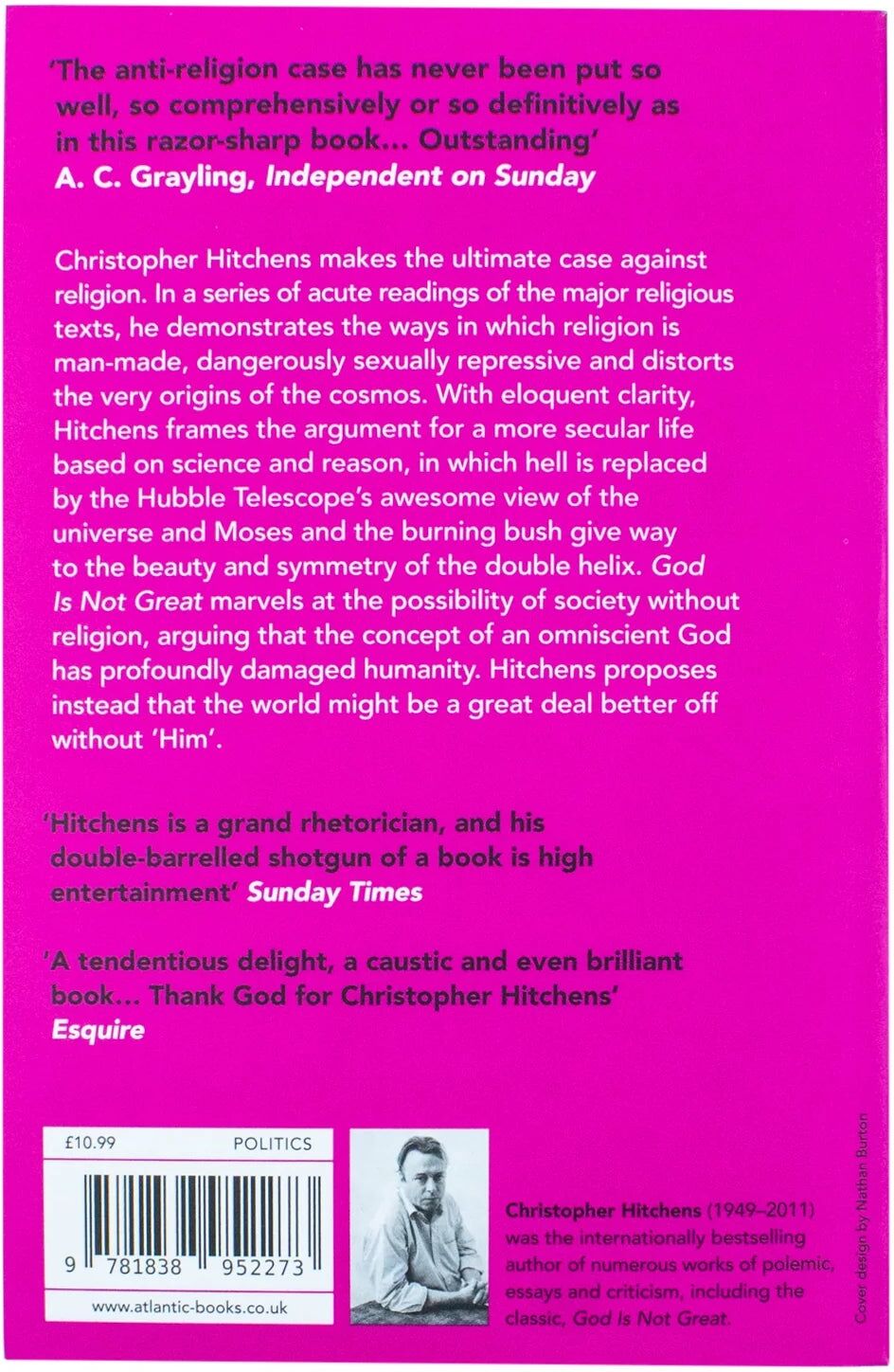
Atlantic Books God Is Not Great: The Case Against Religion by Christopher Hitchens - Paperback - Non-Fiction Religion & Philosophy - NewGod Is Not Great: The Case Against Religion is a fearless and formidably argued polemic by Christopher Hitchens that questions the role of organised religion in human history. Blending sharp wit with rigorous scholarship, Hitchens dissects sacred texts and religious institutions, arguing that faith has too often fuelled division, repression and violence. This landmark work of intellectual non-fiction remains a significant contribution to the discussion of religion and reason, essential reading for those interested in the topic. About the book, Christopher Hitchens builds a comprehensive case against organised religion, drawing on history, philosophy, science and literature. He examines the major world faiths, arguing that religious doctrine is man-made rather than divinely inspired, and that many of its claims are contentious.3,99 £*Shipping: 2,99 £Secure redirect to the provider



-
What are partitive articles in the French language?
Partitive articles in French are used to indicate an unspecified quantity of a noun. They are used when referring to a portion or some of a mass noun, such as food or liquid. The partitive articles in French are "du" (for masculine nouns), "de la" (for feminine nouns), and "de l'" (for nouns starting with a vowel or silent "h"). These articles are essential for expressing the concept of some or any in French. **
-
What is the rule for the partitive article?
The rule for the partitive article in French is to use "de" followed by the definite article (le, la, les) to indicate an unspecified quantity or some of a mass noun. For example, "du" is used for masculine singular nouns, "de la" for feminine singular nouns, and "des" for plural nouns. The partitive article is used when referring to an unknown or unspecified quantity of something. **
-
How do you form the genitive partitive in Latin?
In Latin, the genitive partitive is formed by using the genitive case of the noun followed by the word "partis" or "partis" (depending on the gender of the noun) to indicate a part of the whole. For example, if the noun is "puella" (girl), the genitive partitive would be "puellae partis" to indicate "part of the girl." This construction is used to express the idea of "some of" or "a part of" something. **
-
Can you please help me with the partitive article?
The partitive article is used in French to indicate an unspecified quantity of something. It is often used with uncountable nouns to express "some" or "any" in English. The partitive article changes depending on the gender and number of the noun it precedes. For example, "du" is used before masculine singular nouns, "de la" before feminine singular nouns, and "des" before plural nouns. It is important to use the correct partitive article to indicate the appropriate quantity in French. **


What are partitive articles and quantity increases in French?
Partitive articles in French are used to indicate an unspecified quantity of a noun. They are used with uncountable nouns or when referring to a portion of something. Quantity increases in French involve using words like "plus de" (more), "beaucoup de" (a lot of), or "trop de" (too much) to indicate an increase in the quantity of something. These expressions are used to specify a larger amount of a noun compared to using just the partitive article. **
When do you use the partitive article in French?
The partitive article in French is used to indicate an unspecified quantity of a mass noun. It is used when referring to a part of a whole, or an unspecified amount of something. For example, "du" is used for masculine nouns, "de la" for feminine nouns, and "de l'" for nouns starting with a vowel or silent "h". It is important to use the partitive article when talking about food, drinks, or other uncountable nouns in French. **
Top-Angebote
Products related to Partitive:
-
The End of Faith: Religion, Terror, and the Future of Reason by Sam HarrisDescription. This important and timely book delivers a startling analysis of the clash of faith and reason in today's world. Sam Harris offers a vivid historical tour of mankind's willingness to suspend reason in favour of religious beliefs, even when those beliefs are used to justify harmful behaviour and sometimes heinous crimes. He asserts that in the shadow of weapons of mass destruction, we can no longer tolerate views that pit one true god against another. Most controversially, he argues that we cannot afford moderate lip service to religion -- an accommodation that only blinds us to the real perils of fundamentalism. While warning against the encroachment of organised religion into world politics, Harris also draws on new evidence from neuroscience and insights from philosophy to explore spirituality as a biological, brain-based need. He calls on us to invoke that need in taking a secular humanistic approach to solving the problems of this world.. Title. The End of Faith: Religion, Terror, and the Future of Reason by Sam Harris. Delivery. Content. Reviews6,99 £*Shipping: 2,99 £Secure redirect to the provider
-
Astoria Grand Premium Wooden Quran Stand With Prayer Mat Storage – Islamic Prayer Rack & Home Decor Gold;Brown;Black 89cm H X 66cm W X 30cm DThis wooden Quran stand with integrated prayer mat storage offers a practical and decorative solution for organising your daily prayer essentials. Crafted entirely from natural wood, the piece combines durability with a warm, traditional look suitable for any home prayer corner. The structure features a solid spruce base for stability, solid oak hangers designed to hold multiple prayer mats, and an intricately crafted wooden front panel with Islamic motifs in a gold-inspired finish. The angled top shelf provides a comfortable reading position for the Quran, helping create a calm and organised prayer environment. With its natural wood tones — including brown, black and warm yellow accents — this stand blends easily with a variety of interior styles. Its smooth, polished surface enhances the overall appearance while requiring minimal maintenance. Simply wipe with a dry cloth; avoid water, alcohol or harsh chemicals to preserve the finish. Ideal for living rooms, bedrooms, and dedicated prayer spaces, this piece brings both functionality and a meaningful decorative touch to your home. Dimensions (W × L × H): 11.8" × 26" × 35.43" (30 × 66 × 89 cm) Material: Solid wood (spruce, oak, processed decorative wood) Colour: Natural wood (brown, black, yellow tones) Care: Dry cloth only; avoid water, alcohol and chemicals Brand Name: Astoria Grand.175,99 £*Shipping: 0,00 £Secure redirect to the provider
-
Inspire Curations Islamic Style Car Hanging Ornament Elegant Faith Inspired Rearview Mirror Accessory greenBring elegance, spirituality, and meaningful style to your vehicle with this beautifully crafted Islamic Car Hanging Ornament designed to enhance your driving experience with faithinspired dcor. Featuring an artistic Islamicstyle design with refined...60,50 $*Shipping: 0,00 $Secure redirect to the provider
-
Inspired Finds Islamic Car Hanging Ornament Elegant Faith Inspired Rear View Mirror Decor blackBring a sense of peace, spirituality, and refined style to every journey with this beautifully crafted Islamic car hanging ornament. Designed with elegant Islamic art influences, this hanging accessory adds meaningful decoration to your vehicle...34,99 $*Shipping: 0,00 $Secure redirect to the provider
-
How is the partitive formed?
The partitive is formed in French by using the preposition "de" followed by the definite article "le," "la," or "les." This combination contracts to form "du," "de la," or "des" before a singular or plural noun, respectively. For example, "some bread" is "du pain" and "some apples" is "des pommes." The partitive is used to indicate an unspecified quantity or portion of a mass noun. **
-
What is the French partitive article?
The French partitive article is used to indicate an unspecified quantity of a noun that cannot be counted. It is formed by combining the preposition "de" with the definite article corresponding to the noun's gender and number. For example, "du" is used with masculine singular nouns, "de la" with feminine singular nouns, and "des" with plural nouns. The partitive article is used in French to express concepts like some, any, or a part of something. **
-
What are partitive articles in the French language?
Partitive articles in French are used to indicate an unspecified quantity of a noun. They are used when referring to a portion or some of a mass noun, such as food or liquid. The partitive articles in French are "du" (for masculine nouns), "de la" (for feminine nouns), and "de l'" (for nouns starting with a vowel or silent "h"). These articles are essential for expressing the concept of some or any in French. **
-
What is the rule for the partitive article?
The rule for the partitive article in French is to use "de" followed by the definite article (le, la, les) to indicate an unspecified quantity or some of a mass noun. For example, "du" is used for masculine singular nouns, "de la" for feminine singular nouns, and "des" for plural nouns. The partitive article is used when referring to an unknown or unspecified quantity of something. **
Similar search terms for Partitive
-
Atlantic Books God Is Not Great: The Case Against Religion by Christopher Hitchens - Paperback - Non-Fiction Religion & Philosophy - NewGod Is Not Great: The Case Against Religion is a fearless and formidably argued polemic by Christopher Hitchens that questions the role of organised religion in human history. Blending sharp wit with rigorous scholarship, Hitchens dissects sacred texts and religious institutions, arguing that faith has too often fuelled division, repression and violence. This landmark work of intellectual non-fiction remains a significant contribution to the discussion of religion and reason, essential reading for those interested in the topic. About the book, Christopher Hitchens builds a comprehensive case against organised religion, drawing on history, philosophy, science and literature. He examines the major world faiths, arguing that religious doctrine is man-made rather than divinely inspired, and that many of its claims are contentious.3,99 £*Shipping: 2,99 £Secure redirect to the provider
-
Inspired Finds Islamic Car Hanging Ornament Elegant Faith Inspired Rear View Mirror Decor redBring a sense of peace, spirituality, and refined style to every journey with this beautifully crafted Islamic car hanging ornament. Designed with elegant Islamic art influences, this hanging accessory adds meaningful decoration to your vehicle...34,99 $*Shipping: 0,00 $Secure redirect to the provider
-
Inspired Finds Islamic Car Hanging Ornament Elegant Faith Inspired Rear View Mirror Decor greenBring a sense of peace, spirituality, and refined style to every journey with this beautifully crafted Islamic car hanging ornament. Designed with elegant Islamic art influences, this hanging accessory adds meaningful decoration to your vehicle...34,99 $*Shipping: 0,00 $Secure redirect to the provider
-
How do you form the genitive partitive in Latin?
In Latin, the genitive partitive is formed by using the genitive case of the noun followed by the word "partis" or "partis" (depending on the gender of the noun) to indicate a part of the whole. For example, if the noun is "puella" (girl), the genitive partitive would be "puellae partis" to indicate "part of the girl." This construction is used to express the idea of "some of" or "a part of" something. **
-
Can you please help me with the partitive article?
The partitive article is used in French to indicate an unspecified quantity of something. It is often used with uncountable nouns to express "some" or "any" in English. The partitive article changes depending on the gender and number of the noun it precedes. For example, "du" is used before masculine singular nouns, "de la" before feminine singular nouns, and "des" before plural nouns. It is important to use the correct partitive article to indicate the appropriate quantity in French. **
-
What are partitive articles and quantity increases in French?
Partitive articles in French are used to indicate an unspecified quantity of a noun. They are used with uncountable nouns or when referring to a portion of something. Quantity increases in French involve using words like "plus de" (more), "beaucoup de" (a lot of), or "trop de" (too much) to indicate an increase in the quantity of something. These expressions are used to specify a larger amount of a noun compared to using just the partitive article. **
-
When do you use the partitive article in French?
The partitive article in French is used to indicate an unspecified quantity of a mass noun. It is used when referring to a part of a whole, or an unspecified amount of something. For example, "du" is used for masculine nouns, "de la" for feminine nouns, and "de l'" for nouns starting with a vowel or silent "h". It is important to use the partitive article when talking about food, drinks, or other uncountable nouns in French. **
* All prices are inclusive of VAT and, if applicable, plus shipping costs. The offer information is based on the details provided by the respective shop and is updated through automated processes. Real-time updates do not occur, so deviations can occur in individual cases. ** Note: Parts of this content were created by AI.