Buy امام.com ?
We are moving the project
امام.com .
Are you interested in purchasing the domain
امام.com ?
domain@kv-gmbh.de · 0541-91531010
Buy امام.com ?
Why is Rutherford's scattering experiment called a scattering experiment at all?
Rutherford's experiment is called a scattering experiment because it involved firing alpha particles at a thin gold foil and observing how they scattered after hitting the foil. The term "scattering" refers to the process of particles being deflected from their original path as a result of collisions with the atoms in the foil. By analyzing the pattern of scattering, Rutherford was able to deduce the structure of the atom and propose the existence of a dense, positively charged nucleus at its center. This experiment was crucial in advancing our understanding of atomic structure and the behavior of subatomic particles. **
What was Rutherford's scattering experiment?
Rutherford's scattering experiment involved firing alpha particles at a thin gold foil and observing their deflection. The experiment aimed to study the structure of the atom and determine how the positive charge is distributed within it. The unexpected results of the experiment led Rutherford to propose the nuclear model of the atom, where he suggested that atoms have a small, dense, positively charged nucleus at their center. This experiment was crucial in advancing our understanding of atomic structure. **


Similar search terms for Scattering
Top-Angebote
Products related to Scattering:
-
Inspire Curations Islamic Style Car Hanging Ornament Elegant Faith Inspired Rearview Mirror Accessory blackBring elegance, spirituality, and meaningful style to your vehicle with this beautifully crafted Islamic Car Hanging Ornament designed to enhance your driving experience with faithinspired dcor. Featuring an artistic Islamicstyle design with refined...53,00 $*Shipping: 0,00 $Secure redirect to the provider
-
Inspired Finds Islamic Car Hanging Ornament Elegant Faith Inspired Rear View Mirror Decor greenBring a sense of peace, spirituality, and refined style to every journey with this beautifully crafted Islamic car hanging ornament. Designed with elegant Islamic art influences, this hanging accessory adds meaningful decoration to your vehicle...34,99 $*Shipping: 0,00 $Secure redirect to the provider
-
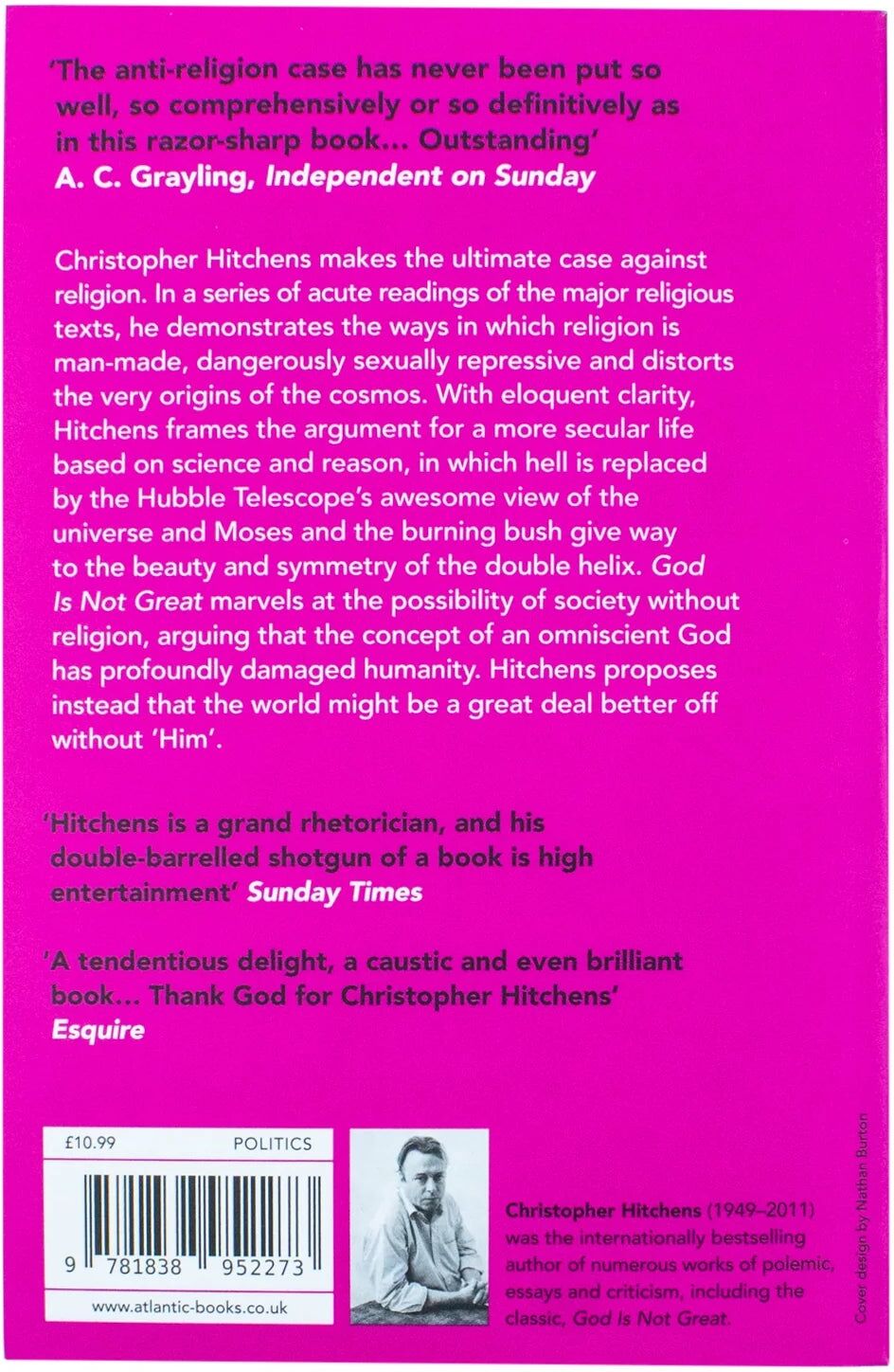
Atlantic Books God Is Not Great: The Case Against Religion by Christopher Hitchens - Paperback - Non-Fiction Religion & Philosophy - NewGod Is Not Great: The Case Against Religion is a fearless and formidably argued polemic by Christopher Hitchens that questions the role of organised religion in human history. Blending sharp wit with rigorous scholarship, Hitchens dissects sacred texts and religious institutions, arguing that faith has too often fuelled division, repression and violence. This landmark work of intellectual non-fiction remains a significant contribution to the discussion of religion and reason, essential reading for those interested in the topic. About the book, Christopher Hitchens builds a comprehensive case against organised religion, drawing on history, philosophy, science and literature. He examines the major world faiths, arguing that religious doctrine is man-made rather than divinely inspired, and that many of its claims are contentious.3,99 £*Shipping: 2,99 £Secure redirect to the provider



-
What is the Rutherford scattering experiment?
The Rutherford scattering experiment was conducted by physicist Ernest Rutherford in 1909. In this experiment, Rutherford bombarded a thin gold foil with alpha particles and observed their scattering patterns. The unexpected results of the experiment led to the discovery of the atomic nucleus and the development of the nuclear model of the atom. The experiment showed that most of the alpha particles passed through the foil, but some were deflected at large angles, indicating the presence of a small, dense nucleus within the atom. This experiment revolutionized our understanding of the structure of the atom. **
-
What is the Rutherford scattering with copper?
Rutherford scattering with copper refers to the experiment conducted by Ernest Rutherford in which he bombarded a thin gold foil with alpha particles. The experiment led to the discovery that atoms have a small, dense nucleus at their center, which was a groundbreaking finding in the field of nuclear physics. The use of copper in the experiment is not common, as gold was the metal foil typically used due to its malleability and ability to be made very thin. **
-
What is the difference between reflection and scattering?
Reflection occurs when light bounces off a surface at the same angle it hits it, resulting in a clear image. Scattering, on the other hand, occurs when light is dispersed in different directions by particles or irregularities in a medium, resulting in a diffuse or hazy appearance. In reflection, the light maintains its original intensity and color, while in scattering, the light may lose intensity and change color due to the interaction with the medium. **
-
What causes the photoelectric effect: absorption or scattering?
The photoelectric effect is caused by absorption of photons by electrons in a material, rather than scattering. When a photon with sufficient energy is absorbed by an electron in a material, it can transfer enough energy to the electron to liberate it from the material, causing the photoelectric effect. Scattering, on the other hand, involves the redirection of photons by particles in a material, but it does not result in the ejection of electrons from the material. **


Why is the Rutherford experiment called the scattering experiment?
The Rutherford experiment is called the scattering experiment because it involved firing alpha particles at a thin gold foil and observing how they scattered after hitting the foil. This scattering of alpha particles provided crucial evidence for the existence of a small, dense nucleus within the atom, as most of the alpha particles passed through the foil with little deflection, but a small fraction were scattered at large angles. This unexpected scattering pattern led to the development of the nuclear model of the atom and revolutionized our understanding of atomic structure. **
Can you explain the Rutherford scattering experiment atomic model?
The Rutherford scattering experiment was conducted by physicist Ernest Rutherford in 1909. In this experiment, Rutherford bombarded a thin gold foil with alpha particles and observed their scattering patterns. According to the prevailing atomic model at the time, the plum pudding model, it was expected that the alpha particles would pass through the foil with minimal deflection. However, Rutherford's observations showed that some alpha particles were deflected at large angles, and even some were reflected back. This led to the development of the nuclear model of the atom, in which the atom is mostly empty space with a small, dense nucleus at the center. This experiment provided evidence for the existence of a positively charged nucleus within the atom, leading to a significant shift in our understanding of atomic structure. **
Top-Angebote
Products related to Scattering:
-
The End of Faith: Religion, Terror, and the Future of Reason by Sam HarrisDescription. This important and timely book delivers a startling analysis of the clash of faith and reason in today's world. Sam Harris offers a vivid historical tour of mankind's willingness to suspend reason in favour of religious beliefs, even when those beliefs are used to justify harmful behaviour and sometimes heinous crimes. He asserts that in the shadow of weapons of mass destruction, we can no longer tolerate views that pit one true god against another. Most controversially, he argues that we cannot afford moderate lip service to religion -- an accommodation that only blinds us to the real perils of fundamentalism. While warning against the encroachment of organised religion into world politics, Harris also draws on new evidence from neuroscience and insights from philosophy to explore spirituality as a biological, brain-based need. He calls on us to invoke that need in taking a secular humanistic approach to solving the problems of this world.. Title. The End of Faith: Religion, Terror, and the Future of Reason by Sam Harris. Delivery. Content. Reviews6,99 £*Shipping: 2,99 £Secure redirect to the provider
-
Astoria Grand Premium Wooden Quran Stand With Prayer Mat Storage – Islamic Prayer Rack & Home Decor Gold;Brown;Black 89cm H X 66cm W X 30cm DThis wooden Quran stand with integrated prayer mat storage offers a practical and decorative solution for organising your daily prayer essentials. Crafted entirely from natural wood, the piece combines durability with a warm, traditional look suitable for any home prayer corner. The structure features a solid spruce base for stability, solid oak hangers designed to hold multiple prayer mats, and an intricately crafted wooden front panel with Islamic motifs in a gold-inspired finish. The angled top shelf provides a comfortable reading position for the Quran, helping create a calm and organised prayer environment. With its natural wood tones — including brown, black and warm yellow accents — this stand blends easily with a variety of interior styles. Its smooth, polished surface enhances the overall appearance while requiring minimal maintenance. Simply wipe with a dry cloth; avoid water, alcohol or harsh chemicals to preserve the finish. Ideal for living rooms, bedrooms, and dedicated prayer spaces, this piece brings both functionality and a meaningful decorative touch to your home. Dimensions (W × L × H): 11.8" × 26" × 35.43" (30 × 66 × 89 cm) Material: Solid wood (spruce, oak, processed decorative wood) Colour: Natural wood (brown, black, yellow tones) Care: Dry cloth only; avoid water, alcohol and chemicals Brand Name: Astoria Grand.175,99 £*Shipping: 0,00 £Secure redirect to the provider
-
Inspire Curations Islamic Style Car Hanging Ornament Elegant Faith Inspired Rearview Mirror Accessory blackBring elegance, spirituality, and meaningful style to your vehicle with this beautifully crafted Islamic Car Hanging Ornament designed to enhance your driving experience with faithinspired dcor. Featuring an artistic Islamicstyle design with refined...53,00 $*Shipping: 0,00 $Secure redirect to the provider
-
Inspired Finds Islamic Car Hanging Ornament Elegant Faith Inspired Rear View Mirror Decor greenBring a sense of peace, spirituality, and refined style to every journey with this beautifully crafted Islamic car hanging ornament. Designed with elegant Islamic art influences, this hanging accessory adds meaningful decoration to your vehicle...34,99 $*Shipping: 0,00 $Secure redirect to the provider
-
Why is Rutherford's scattering experiment called a scattering experiment at all?
Rutherford's experiment is called a scattering experiment because it involved firing alpha particles at a thin gold foil and observing how they scattered after hitting the foil. The term "scattering" refers to the process of particles being deflected from their original path as a result of collisions with the atoms in the foil. By analyzing the pattern of scattering, Rutherford was able to deduce the structure of the atom and propose the existence of a dense, positively charged nucleus at its center. This experiment was crucial in advancing our understanding of atomic structure and the behavior of subatomic particles. **
-
What was Rutherford's scattering experiment?
Rutherford's scattering experiment involved firing alpha particles at a thin gold foil and observing their deflection. The experiment aimed to study the structure of the atom and determine how the positive charge is distributed within it. The unexpected results of the experiment led Rutherford to propose the nuclear model of the atom, where he suggested that atoms have a small, dense, positively charged nucleus at their center. This experiment was crucial in advancing our understanding of atomic structure. **
-
What is the Rutherford scattering experiment?
The Rutherford scattering experiment was conducted by physicist Ernest Rutherford in 1909. In this experiment, Rutherford bombarded a thin gold foil with alpha particles and observed their scattering patterns. The unexpected results of the experiment led to the discovery of the atomic nucleus and the development of the nuclear model of the atom. The experiment showed that most of the alpha particles passed through the foil, but some were deflected at large angles, indicating the presence of a small, dense nucleus within the atom. This experiment revolutionized our understanding of the structure of the atom. **
-
What is the Rutherford scattering with copper?
Rutherford scattering with copper refers to the experiment conducted by Ernest Rutherford in which he bombarded a thin gold foil with alpha particles. The experiment led to the discovery that atoms have a small, dense nucleus at their center, which was a groundbreaking finding in the field of nuclear physics. The use of copper in the experiment is not common, as gold was the metal foil typically used due to its malleability and ability to be made very thin. **
Similar search terms for Scattering
-
Atlantic Books God Is Not Great: The Case Against Religion by Christopher Hitchens - Paperback - Non-Fiction Religion & Philosophy - NewGod Is Not Great: The Case Against Religion is a fearless and formidably argued polemic by Christopher Hitchens that questions the role of organised religion in human history. Blending sharp wit with rigorous scholarship, Hitchens dissects sacred texts and religious institutions, arguing that faith has too often fuelled division, repression and violence. This landmark work of intellectual non-fiction remains a significant contribution to the discussion of religion and reason, essential reading for those interested in the topic. About the book, Christopher Hitchens builds a comprehensive case against organised religion, drawing on history, philosophy, science and literature. He examines the major world faiths, arguing that religious doctrine is man-made rather than divinely inspired, and that many of its claims are contentious.3,99 £*Shipping: 2,99 £Secure redirect to the provider
-
Inspired Finds Islamic Car Hanging Ornament Elegant Faith Inspired Rear View Mirror Decor blackBring a sense of peace, spirituality, and refined style to every journey with this beautifully crafted Islamic car hanging ornament. Designed with elegant Islamic art influences, this hanging accessory adds meaningful decoration to your vehicle...34,99 $*Shipping: 0,00 $Secure redirect to the provider
-
Inspire Curations Islamic Style Car Hanging Ornament Elegant Faith Inspired Rearview Mirror Accessory greenBring elegance, spirituality, and meaningful style to your vehicle with this beautifully crafted Islamic Car Hanging Ornament designed to enhance your driving experience with faithinspired dcor. Featuring an artistic Islamicstyle design with refined...60,50 $*Shipping: 0,00 $Secure redirect to the provider
-
What is the difference between reflection and scattering?
Reflection occurs when light bounces off a surface at the same angle it hits it, resulting in a clear image. Scattering, on the other hand, occurs when light is dispersed in different directions by particles or irregularities in a medium, resulting in a diffuse or hazy appearance. In reflection, the light maintains its original intensity and color, while in scattering, the light may lose intensity and change color due to the interaction with the medium. **
-
What causes the photoelectric effect: absorption or scattering?
The photoelectric effect is caused by absorption of photons by electrons in a material, rather than scattering. When a photon with sufficient energy is absorbed by an electron in a material, it can transfer enough energy to the electron to liberate it from the material, causing the photoelectric effect. Scattering, on the other hand, involves the redirection of photons by particles in a material, but it does not result in the ejection of electrons from the material. **
-
Why is the Rutherford experiment called the scattering experiment?
The Rutherford experiment is called the scattering experiment because it involved firing alpha particles at a thin gold foil and observing how they scattered after hitting the foil. This scattering of alpha particles provided crucial evidence for the existence of a small, dense nucleus within the atom, as most of the alpha particles passed through the foil with little deflection, but a small fraction were scattered at large angles. This unexpected scattering pattern led to the development of the nuclear model of the atom and revolutionized our understanding of atomic structure. **
-
Can you explain the Rutherford scattering experiment atomic model?
The Rutherford scattering experiment was conducted by physicist Ernest Rutherford in 1909. In this experiment, Rutherford bombarded a thin gold foil with alpha particles and observed their scattering patterns. According to the prevailing atomic model at the time, the plum pudding model, it was expected that the alpha particles would pass through the foil with minimal deflection. However, Rutherford's observations showed that some alpha particles were deflected at large angles, and even some were reflected back. This led to the development of the nuclear model of the atom, in which the atom is mostly empty space with a small, dense nucleus at the center. This experiment provided evidence for the existence of a positively charged nucleus within the atom, leading to a significant shift in our understanding of atomic structure. **
* All prices are inclusive of VAT and, if applicable, plus shipping costs. The offer information is based on the details provided by the respective shop and is updated through automated processes. Real-time updates do not occur, so deviations can occur in individual cases. ** Note: Parts of this content were created by AI.